
Key Takeaways
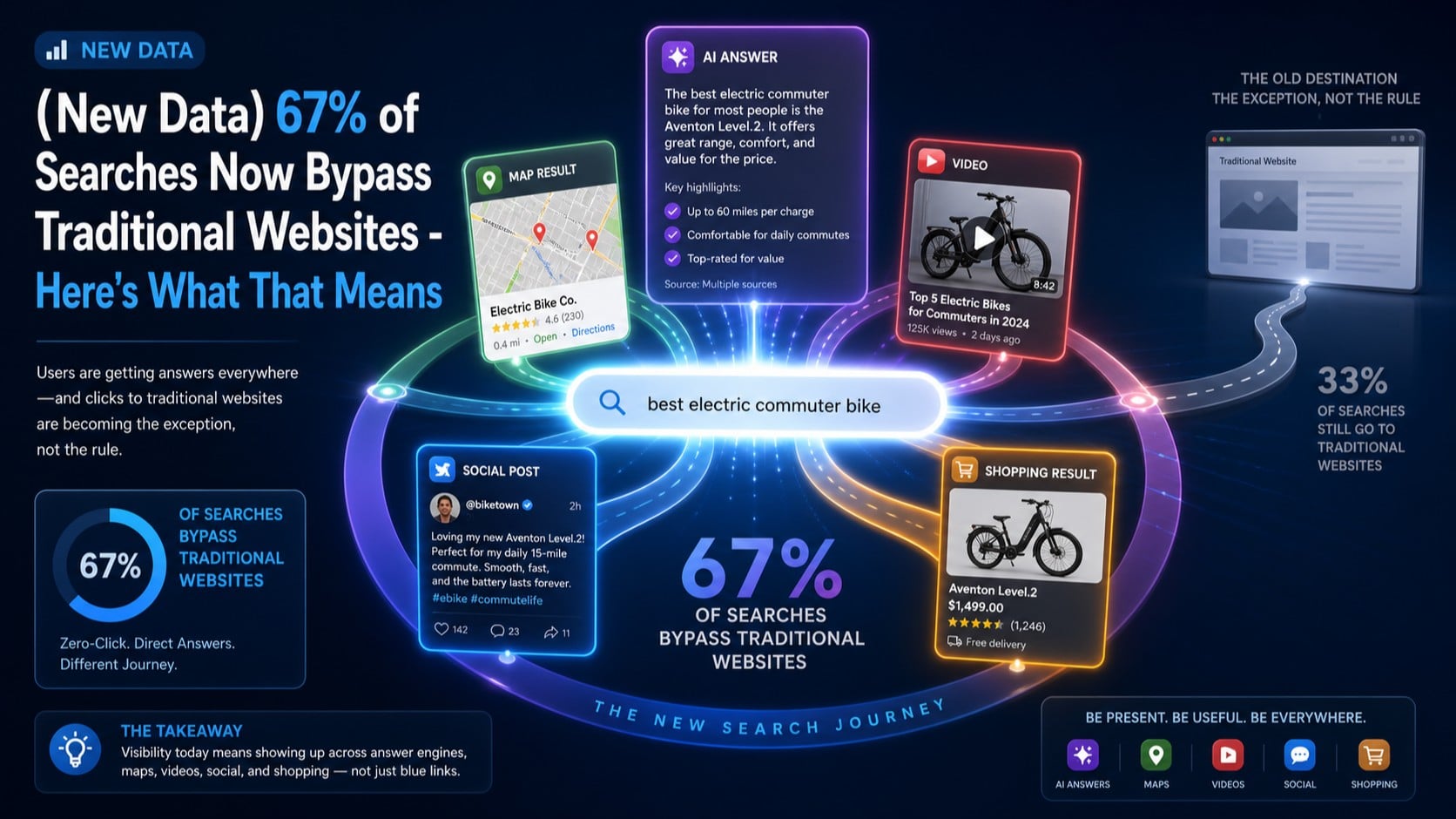
- In the first four months of 2026, 68.01% of U.S. Google searches ended without a single click to an external website – a 7.56-point jump in just two years.
- When Google’s AI Overviews appear, the #1 organic result can lose up to 58% of its click-through rate, and users click any traditional link only 8% of the time.
- Mobile search is even more zero-click heavy: 77.2% of mobile searches never leave the results page.
- The fix is not abandoning SEO – it is expanding it. Answer Engine Optimization (AEO), structured content, and AI citation strategies are now essential components of a modern search playbook.
- Tracking brand visibility and AI presence alongside traditional traffic metrics is quickly becoming the new standard for measuring real search performance.
Search did not die. It got smarter – and a lot less generous with clicks. For digital marketers and SEO professionals, that is not a minor footnote. It is a fundamental rethink of how visibility, traffic, and conversions actually connect in 2026.
68% of Searches End Before Your Site Loads
The numbers are hard to argue with. According to Search Engine Land’s summary of SparkToro’s June 2026 research, 68.01% of Google searches in the United States ended without a click in the first four months of 2026. That is a 7.56-percentage-point increase in just two years, marking a clear tipping point. For the first time, a decisive majority of searches resolve entirely on the results page, with users walking away satisfied before your website ever has a chance to load.
The share of searches generating at least one click fell by 9.51 percentage points between 2024 and 2026, according to the same research. Users are not bouncing back to Google after a bad result – they are simply not leaving Google at all. The search engine has become the destination, not the doorway.
For a closer look at how this same dynamic is reshaping buyer behavior – especially in high-intent service categories – Profit Acuity’s breakdown on AI search as the new first salesperson is worth reading alongside this data.
Google Is Now an Answer Engine
From Traffic Channel to Answer Channel
Google’s original value proposition was simple: point people to other websites. That model has quietly changed. Today, featured snippets, knowledge panels, AI Overviews, map packs, product carousels, and direct answer boxes mean that Google increasingly is the answer – not just the path to one.
The website has not lost its value, but its role has shifted. For many queries, it now functions more like a source of record that supports what users already absorbed on the SERP. The first touchpoint in the customer journey is no longer a homepage – it is increasingly a paragraph inside a search result.
What Actually Stops the Click
Zero-click behavior follows the nature of the query. Simple, factual questions – “How many ounces in a cup?” or “Who is the CEO of Tesla?” – resolve instantly on the SERP, leaving no reason to click further. The same logic applies to local searches and to an expanding range of informational queries now handled by AI Overviews. The easier the answer, the more likely search resolves it on the spot.
AI Overviews Are Gutting Organic CTR
58% CTR Drop at Position One
Ranking first on Google used to be the goal. It still matters – but when an AI Overview is present, the #1 organic position can see a click-through rate drop of as much as 58%. That is not a rounding error. An asset that once drove meaningful traffic can become nearly invisible in terms of clicks, even while technically maintaining its ranking.
Google’s AI Overviews are powered by the Gemini large language model and synthesize information from multiple web sources into a single, concise summary displayed at the very top of results. Users can filter them out using the “Web” tab, though most never do, and no straightforward universal opt-out setting exists.
Users Click Links Only 8% of the Time
A Pew Research Center study sharpened the picture further: when an AI Overview is present, users click traditional search result links only 8% of the time. Without an AI Overview, that number is 15%. That is already low – but the presence of an AI summary effectively cuts click behavior in half. For content-heavy sites built on informational traffic, that is a material revenue risk hiding inside a ranking report that still looks healthy.
Mobile Makes It Worse
Desktop search is already trending zero-click, but mobile is in a different category. 77.2% of mobile searches end without a click to any external website, compared to 46.5% on desktop. Given that mobile now accounts for the majority of global search volume, that gap matters enormously.
On a phone, users are often looking for fast answers – a business address, a quick fact, a store’s hours. The mobile SERP is built to satisfy those needs instantly, with tap-to-call buttons, map directions, and rich snippets front and center. The friction of loading a full website gets skipped entirely. Any strategy that does not account for the mobile zero-click reality is working with an incomplete picture.
Local SEO Has a New Front Door
Google Business Profile Over Homepage Rankings
For local businesses, the search journey often ends before the business website is ever visited. A user searching for a plumber, dentist, or restaurant typically encounters the Map Pack – complete with ratings, hours, photos, a phone number, and a directions button – before seeing a single organic result.
A well-optimized Google Business Profile, a steady stream of genuine customer reviews, and a strong Map Pack position have become more mission-critical than homepage rankings for many local operators. The SERP is the storefront. Consumers find, evaluate, and contact businesses directly from the results page, often without clicking through to the website at all.
Adapt with Answer Engine Optimization (AEO)
Structure Content to Be Cited, Not Just Ranked
Answer Engine Optimization (AEO) is the practice of structuring content so that search engines and AI systems can confidently use it as a direct answer to a user’s question. The priority shifts from keyword density and link equity toward usefulness, clarity, and machine-readable meaning.
In practice, that means:
- Clear, descriptive headings that match the way users phrase questions
- Direct answers early in the content – do not bury the lead under paragraphs of preamble
- Schema markup to help AI tools extract and categorize information accurately
- Tight definitions and clean structure that make content easy to quote in a summary
A concrete example: Position Digital helped Oriel Partners achieve AI Overview visibility for 17 keywords through a single blog post – demonstrating that a well-structured, cite-worthy piece of content can punch significantly above its weight in an AI-first search environment.
AI Citations Can Actually Lift CTR
Here is the counterintuitive finding that many SEO professionals are still overlooking: pages cited within AI Overviews see an average 18% increase in click-through rates compared to traditional organic rankings. Being the source Google’s AI summarizes is not just a consolation prize for lost traffic – it can be a genuine CTR advantage.
The implication is significant. The goal is not to avoid AI Overviews; it is to be inside them. Content that earns citations gets both the visibility of the AI summary and a higher-quality click from a user who already trusts the source.
Stop Measuring Traffic Alone
Track Brand Visibility and AI Presence Instead
Traditional SEO dashboards – sessions, pageviews, organic CTR – were built for a world where every search visit ended on a website. That world is shrinking fast. These metrics are becoming less reliable as standalone indicators of search success.
A more complete measurement framework for 2026 includes:
- AI visibility score – how often does your content appear in AI Overviews or AI-generated answers?
- SERP feature share – are you present in featured snippets, map packs, and knowledge panels?
- Brand sentiment – what is the quality of your brand mentions across the SERP and third-party sources?
Organic traffic can stay flat or even decline while brand visibility and trust are actively growing. Measuring only one side of that equation produces a distorted picture of what is actually working.
Optimize for the Answer – Not Just the Click
The core shift is this: visibility and traffic are no longer the same thing. A brand can be present at every stage of the search journey – cited in an AI Overview, listed in a map pack, mentioned in a Reddit thread surfaced by Google – and still show modest click numbers. That presence is valuable. It shapes perception, builds familiarity, and influences decisions that eventually convert somewhere downstream.
The practical rule for 2026 is to optimize for both. Make content click-worthy for users who want to go deeper, and cite-worthy for the AI systems and SERP features that increasingly answer the question before a click ever happens. Those are not competing goals – they are the same content strategy, executed with more precision.
Traditional SEO is not dead. It is just not the whole game anymore. Broadening the strategy to include AEO, structured data, Google Business Profile optimization, and AI presence tracking is how serious SEO professionals stay relevant as the SERP keeps evolving.
Profit Acuity helps businesses track and respond to exactly these kinds of shifts in AI-driven search visibility – check out the tools at app.profitacuity.com.
Profit Acuity
+1 877 624 1229
239 Fourth Ave, Ste 1401 #8511
Pittsburgh
PA
15222
United States


