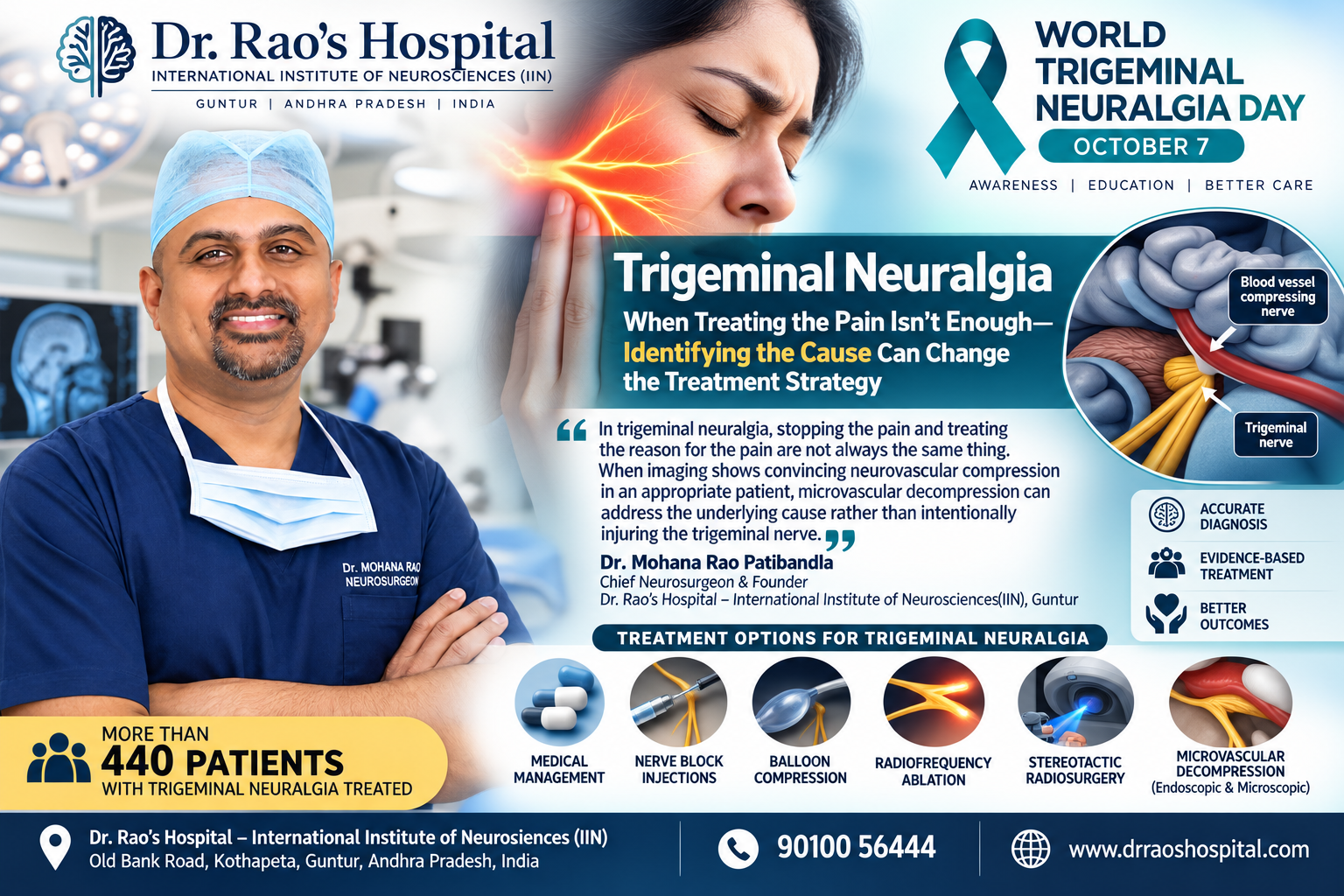
Dr. Rao’s IIN reports experience treating more than 440 patients and highlights when identifying neurovascular compression can change the treatment strategy
GUNTUR, ANDHRA PRADESH, INDIA, October 7, 2026 /EINPresswire.com/ — For some people with trigeminal neuralgia, the search for pain relief can become a cycle of medications, injections and repeat procedures—while the underlying cause of the pain remains unaddressed. On World Trigeminal Neuralgia Awareness Day, a Guntur neurosurgeon is urging clinicians and patients to ask a different question when appropriate imaging demonstrates convincing neurovascular compression: can the cause of the pain itself be treated?
Dr. Mohana Rao Patibandla, Chief Neurosurgeon and founder of Dr. Rao’s Hospital – International Institute of Neurosciences (IIN) in Guntur, says that distinction can be particularly important in patients with classical trigeminal neuralgia, where a blood vessel compresses the trigeminal nerve and contributes to the characteristic attacks of severe facial pain.
Drawing on experience treating more than 440 patients with trigeminal neuralgia, Dr. Rao’s IIN reports approximately 213 microvascular decompression (MVD) procedures, including around 114 performed using endoscopic techniques, alongside experience with stereotactic radiosurgery, balloon compression and radiofrequency procedures.
“In trigeminal neuralgia, stopping the pain and treating the reason for the pain are not always the same thing,” said Dr. Mohana Rao Patibandla. “When the clinical picture is consistent with classical trigeminal neuralgia and imaging demonstrates convincing neurovascular compression in an otherwise suitable patient, microvascular decompression can address the underlying conflict rather than intentionally injuring the trigeminal nerve. That distinction matters when we are thinking about long-term pain control and preservation of facial sensation.”
The question behind the pain
Trigeminal neuralgia causes recurrent attacks of severe facial pain, often described as electric shocks, stabbing or lightning-like sensations. Talking, chewing, brushing the teeth, touching the face or even a light breeze can trigger an attack.
Because the pain is felt around the jaw, cheek or teeth, some patients initially seek dental treatment. When dental disease does not adequately explain the attacks, a neurological cause needs to be considered.
The American Family Physician’s 2025 rapid evidence review recommends brain MRI for patients with suspected trigeminal neuralgia to help exclude other causes and assess factors relevant to treatment and surgical candidacy.
The European Academy of Neurology guideline similarly recommends MRI as part of the diagnostic work-up and distinguishes classical trigeminal neuralgia, associated with neurovascular contact/compression, from idiopathic and secondary forms. Importantly, the guideline cautions that neurovascular contact on MRI should not by itself establish the diagnosis; the imaging must be interpreted alongside the clinical picture.
When the MRI changes the conversation
Not every patient with trigeminal neuralgia has the same underlying mechanism, and simply seeing a blood vessel near the trigeminal nerve does not automatically mean that the vessel is responsible for the pain.
But when the clinical features are consistent with classical trigeminal neuralgia and the imaging demonstrates a convincing neurovascular relationship, the treatment discussion can change.
Microvascular decompression does not deliberately destroy the trigeminal nerve. Instead, the surgeon identifies the offending vascular structure and separates it from the nerve, typically placing a protective material between them to relieve the conflict.
This differs fundamentally from procedures that intentionally interrupt trigeminal nerve transmission to control pain.
“The MRI should never be interpreted in isolation,” Dr. Rao said. “We have to match the imaging with the patient’s symptoms and neurological examination. But when the clinical picture and imaging tell the same story, it becomes important to discuss whether the underlying neurovascular conflict should be treated.”
Why MVD matters when long-term pain relief is the goal
The distinction between procedures becomes particularly important when the objective is not simply to obtain pain relief today, but to achieve durable pain control while preserving facial sensation whenever possible.
The European Academy of Neurology guideline recommends microvascular decompression as first-line surgery for classical trigeminal neuralgia when surgery is indicated.
Comparative evidence also supports the role of MVD as the surgical benchmark for appropriately selected patients. A systematic review and meta-analysis comparing MVD with stereotactic radiosurgery found higher rates of short- and long-term pain freedom with MVD, together with less facial numbness and dysesthesia, although MVD was associated with more postoperative complications.
A prospective long-term comparison reported pain-free rates after MVD of 83% at five years, compared with 47% after stereotactic radiosurgery, and a longer median time to pain recurrence after MVD.
More recent comparative evidence has likewise reported longer pain-free intervals and lower recurrence following MVD compared with radiofrequency ablation and stereotactic radiosurgery, while emphasizing the higher procedural risk associated with MVD.
“When a medically fit patient has classical trigeminal neuralgia and convincing neurovascular compression, MVD deserves to be discussed as the benchmark surgical option because of its potential for durable pain relief without deliberately injuring the trigeminal nerve,” Dr. Rao said.
“But benchmark does not mean suitable for everyone. The patient’s age, medical fitness, MRI findings, previous procedures and willingness to accept the risks of intracranial surgery all matter.”
The alternative is not “no treatment”
Not every patient is an appropriate candidate for MVD.
An older patient with significant medical comorbidities, a patient who does not want an intracranial operation, or a patient without convincing neurovascular compression may be better served by a less invasive approach.
Treatment options may include:
Medical therapy for patients who achieve adequate control
Nerve-block and injection-based treatment in selected circumstances
Radiofrequency ablation through the foramen ovale
Balloon compression/rhizotomy
Stereotactic radiosurgery
Microvascular decompression
Endoscopic-assisted or endoscopic MVD in appropriately selected cases
The European Academy of Neurology guideline recommends surgery when pain is inadequately controlled with medication or medication is poorly tolerated, with the choice of procedure guided by the type of trigeminal neuralgia and individual circumstances.
More than 440 patients: experience across the treatment spectrum
Dr. Rao’s IIN reports treatment experience involving more than 440 patients with trigeminal neuralgia.
Its reported procedural experience includes approximately:
213 microvascular decompression procedures
114 endoscopic MVD procedures
76 stereotactic radiosurgery procedures
35 balloon compression/rhizotomy procedures
120 radiofrequency ablation procedures
These figures represent institutional procedural experience and not unique patient counts; an individual patient may undergo more than one procedure during the course of treatment.
Dr. Rao says this breadth of experience is important because the decision should not be driven by a single preferred technique.
“Having several treatment options is valuable only if we use them selectively,” he said. “Our objective is not to offer every procedure to every patient. It is to identify the mechanism of the pain, understand the patient’s anatomy and medical risk, and then choose the treatment whose benefits and risks make the most sense for that individual.”
When repeated treatment should prompt a reassessment
Repeated procedures can provide important relief and remain appropriate for patients who are not candidates for MVD or who prefer a less invasive approach.
However, recurrent pain should also prompt a reassessment of the diagnosis, imaging and treatment strategy rather than automatically repeating the same procedure.
“If a patient keeps returning because the pain comes back, that should trigger a reassessment,” Dr. Rao said. “We should ask whether the diagnosis remains consistent with classical trigeminal neuralgia, whether there is a convincing neurovascular conflict, what previous procedures have changed, and whether the treatment strategy needs to change.”
Five questions patients should ask before a procedure
Dr. Rao’s IIN recommends that patients discussing procedural treatment ask:
1. Does my clinical picture fit classical trigeminal neuralgia?
2. Does my MRI show convincing neurovascular compression of the trigeminal nerve?
3. If MVD is being considered, what is my expected chance of durable pain relief and what are the operative risks?
4. If a less invasive procedure is recommended, how quickly should I expect pain relief, how durable is it likely to be, and what is the risk of facial numbness?
5. If the pain returns, what will the next treatment option be?
These questions shift the discussion away from simply asking which procedure has the highest success rate.
The more useful question is which treatment offers the best balance of durable pain control, sensory preservation, procedural risk and patient preference for this particular person.
Treating the cause when the cause can be identified
For Dr. Rao, World Trigeminal Neuralgia Awareness Day is an opportunity to move the conversation beyond recognizing the severity of facial pain.
It is also an opportunity to ask whether the underlying mechanism has been properly investigated.
“Trigeminal neuralgia is often described simply as severe facial pain, but for some patients there is an identifiable anatomical problem behind that pain,” Dr. Rao said. “When the clinical diagnosis, imaging and patient profile point toward neurovascular compression, we should not overlook the possibility of treating the cause rather than repeatedly treating only the symptom.”
The message is not that every patient with trigeminal neuralgia requires surgery.
It is that when classical trigeminal neuralgia, convincing neurovascular compression and appropriate surgical candidacy come together, microvascular decompression deserves serious consideration because it offers the potential for durable pain relief while preserving facial sensation.
Evidence and Clinical References
Bendtsen L, Zakrzewska JM, Abbott J, et al. European Academy of Neurology guideline on trigeminal neuralgia. European Journal of Neurology. 2019;26(6):831–849. doi:10.1111/ene.13950. The guideline recommends MRI in the diagnostic work-up and MVD as first-line surgery for classical trigeminal neuralgia when surgery is indicated.
Amaechi O. Trigeminal Neuralgia: Rapid Evidence Review. American Family Physician. 2025;111(5):427–432. The review describes MRI-based evaluation, medical treatment and the role of surgical referral for refractory disease.
Ferroli P, et al. First treatment and retreatment of medically refractive trigeminal neuralgia by stereotactic radiosurgery versus microvascular decompression: a systematic review and meta-analysis. The analysis found higher short- and long-term pain freedom with MVD than SRS, with fewer sensory complications but greater postoperative complications.
Hussain MA, et al. Microvascular decompression versus stereotactic radiosurgery as primary treatment modality for trigeminal neuralgia: a systematic review and meta-analysis of prospective comparative trials. The pooled prospective evidence favored MVD for initial and longer-term pain relief and showed lower rates of facial numbness compared with Gamma Knife radiosurgery.
Prospective comparison of long-term pain relief rates after first-time microvascular decompression and stereotactic radiosurgery for trigeminal neuralgia. Long-term follow-up demonstrated higher pain-free rates and longer median time to recurrence following MVD than SRS.
Medically Refractory Trigeminal Neuralgia: A Comparative Study of Outcomes of Microvascular Decompression versus Gamma Knife Radiosurgery and Percutaneous Radiofrequency Ablation. The study reported longer median pain-free intervals and lower recurrence with MVD than with the compared alternatives, while acknowledging the different risk profiles.
About Dr. Rao’s Hospital – International Institute of Neurosciences (IIN)
Dr. Rao’s Hospital – International Institute of Neurosciences (IIN) in Guntur, Andhra Pradesh, is a dedicated neurosciences centre providing neurosurgical and neurological care, including minimally invasive neurosurgery, skull base surgery, pediatric neurosurgery, cerebrovascular and endovascular neurosurgery, neuro-oncology and stereotactic radiosurgery.
The institution incorporates advanced neurosurgical infrastructure including intraoperative neurophysiological monitoring, neuronavigation, a hybrid operating theatre and a biplane catheterisation laboratory.
About Dr. Mohana Rao Patibandla
Dr. Mohana Rao Patibandla is a neurosurgeon based in Guntur with training and experience spanning minimally invasive neurosurgery, skull base surgery, pediatric neurosurgery, cerebrovascular and endovascular neurosurgery, neuro-oncology and stereotactic radiosurgery. He is the founder and Chief Neurosurgeon of Dr. Rao’s Hospital – International Institute of Neurosciences.
Media Contact
Dr. Rao’s Hospital – International Institute of Neurosciences (IIN)
Old Bank Road, Kothapeta, Guntur, Andhra Pradesh, India
Phone: 9010056444
Email: info@drraoshospitals.com
Mohana Rao Patibandla
Patibandla Narayana Swamy Neurosciences LLP
+91 90100 56444
info@drraoshospitals.com
Visit us on social media:
LinkedIn
Instagram
Facebook
YouTube
X
Dr. Rao’s Hosptial – the best neurosurgery hospital in India – with medical tourism
Legal Disclaimer:
EIN Presswire provides this news content “as is” without warranty of any kind. We do not accept any responsibility or liability
for the accuracy, content, images, videos, licenses, completeness, legality, or reliability of the information contained in this
article. If you have any complaints or copyright issues related to this article, kindly contact the author above.

Media gallery