
Key Takeaways
- Student engagement is essential to meaningful STEM learning, but creating relevant, hands-on experiences can be challenging for educators managing demanding workloads.
- Connecting science to everyday experiences, including nutrition, physical activity, and environmental health, can help students recognize the value of what they learn.
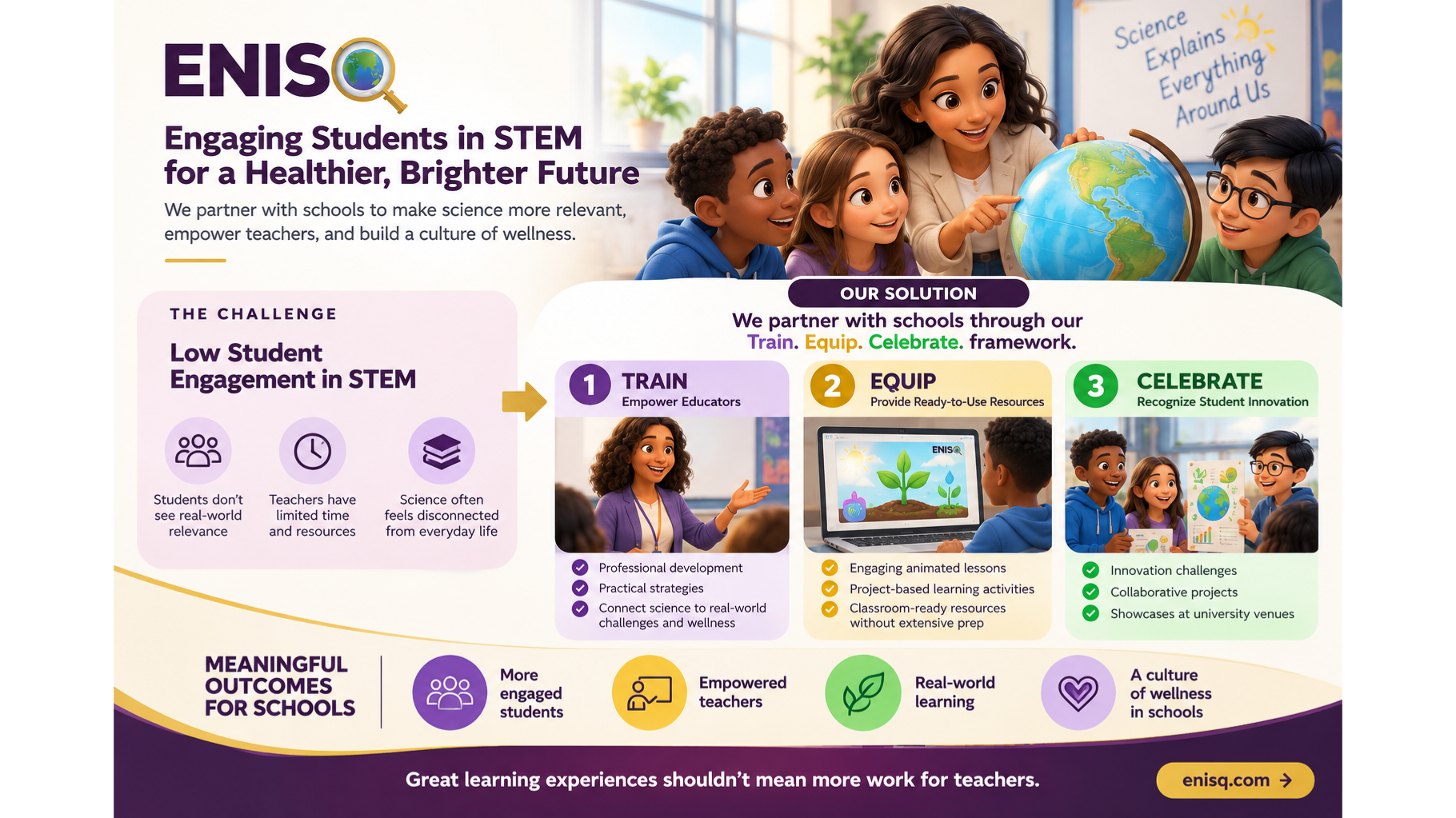
- ENISQ partners with schools through its Train. Equip. Celebrate. framework, combining teacher professional development, ready-to-use instructional resources, and student innovation opportunities.
- Integrating nutrition and health into STEM education creates opportunities for schools to foster a culture of wellness while strengthening scientific understanding.
- Meaningful learning experiences should support teachers, not create additional responsibilities.
What if the biggest challenge in science education isn’t what students are learning, but whether they understand why it matters?
Students learn about energy, chemical reactions, ecosystems, and human biology. Yet many struggle to connect these concepts to everyday decisions, from what they eat to how their bodies function and how their communities address environmental challenges.
This disconnect matters.
Research on science education increasingly emphasizes the importance of connecting classroom learning to real-world experiences. The National Academies’ A Framework for K-12 Science Education highlights the value of engaging students in scientific practices and applying knowledge to meaningful problems.
But making these connections requires something teachers often have too little of: time.
The Challenge of Engagement in an Already Crowded Classroom
Teachers are navigating demanding curricula, diverse learning needs, assessment requirements, and limited preparation time. Designing hands-on, project-based experiences can become another responsibility in an already demanding profession.
Yet meaningful STEM education requires more than memorizing scientific facts. Students need opportunities to ask questions, investigate problems, think critically, and apply what they learn.
Consider a lesson on cellular respiration. Rather than simply learning how cells produce energy, students could explore how their bodies use nutrients during physical activity. A lesson on ecosystems could become an investigation into food waste, sustainability, or local food systems.
These connections make science tangible. They also create opportunities to integrate nutrition and health education into existing STEM instruction.
The challenge is making such experiences accessible without placing additional demands on educators.
A Different Approach: Support Teachers, Engage Students
One emerging approach is to combine teacher development, ready-to-use instructional resources, and opportunities for students to apply their knowledge.
ENISQ, an educational technology platform focused on STEM and health education, is developing this model through its Train. Equip. Celebrate. framework.
The approach begins with professional development that helps teachers connect scientific concepts to everyday experiences. Educators receive animated lessons, worksheets, and project-based learning resources designed to complement classroom instruction.
Students then participate in innovation challenges where they explore problems such as food insecurity, healthy eating, and environmental sustainability, developing ideas they can present at culminating showcases.
Rather than introducing an entirely separate curriculum, the model aims to make existing science instruction more engaging and relevant while reducing preparation demands.
Science Education as a Foundation for Healthier Communities
The potential benefits extend beyond academic engagement.
When students understand how nutrition influences their bodies, how food systems affect the environment, or how scientific evidence informs health decisions, they gain knowledge that can shape their choices and perspectives.
Schools have an opportunity to nurture scientific literacy and health awareness together, helping students see themselves not simply as learners of science, but as people capable of using science to solve problems.
Achieving this vision will require approaches that respect teachers’ time while giving students more opportunities to explore, question, and create.
The future of meaningful STEM education may depend less on teaching more content and more on helping students discover why what they learn matters.
About ENISQ
ENISQ is an educational technology platform that partners with schools to connect STEM education with nutrition, health, and real-world problem-solving. Through teacher professional development, ready-to-use resources, and student innovation challenges, ENISQ aims to make science learning more engaging without increasing teachers’ workloads.
Learn more at enisq.com.
ENISQ
1 Mount Olive Rd
Unit 343
Budd Lake
NJ
07828
United States


