Boston IT Support Provider Explains Managed IT Across Key Industries in Boston Businesses
Boston, United States – May 4, 2026 / Daystar – Boston Managed IT Services Company /

IT Support Provider in Boston Shares How Top Industries Use Managed IT
BOSTON, MA, May 4, 2026 — Daystar today announced its Industry-Focused IT Support Advisory Program, a new initiative designed to help Boston businesses assess technology needs across key sectors including healthcare, finance, public services, education, legal services, architecture, engineering, and scientific research.
Boston serves as a major economic center with a regional gross product of about $571 billion. Additionally, Massachusetts recently ranked as the strongest state economy in the U.S., due in large part to technology, research, and higher education. Yet, there are a few specific Boston industries that account for the most jobs and the highest economic output.
|
“Given Boston’s complex tech landscape, virtually any business can improve efficiency and security by partnering with a capable IT service provider.” – Mike Ransom, Virtual CIO, Daystar |
Still, no matter which industry you work in, you need efficient IT to keep operations running smoothly. 92% of jobs require digital skills, and far too many organizations find it challenging to fulfill these roles. For this reason, even businesses who work in the biggest industries in Boston are turning to managed IT services.
In this article, a reliable Boston IT support provider explores the seven leading industries in Boston, why technology plays such a critical role in each one, and how the right managed IT service provider can help support daily operations.
The 7 Biggest Industries in Boston, Massachusetts
1. Healthcare
Healthcare is Boston’s largest industry by employment, with about 136,000 workers in the city. This sector spans world-renowned hospitals, such as Massachusetts General Hospital, Brigham and Women’s, and Boston Children’s, as well as top clinics and research institutions.
2. Finance & Insurance
The financial and insurance sectors account for 12% of all jobs in Boston. This statistic is unsurprising. Boston has a long history as a financial center and is home to firms such as Fidelity Investments and State Street Corp. Furthermore, finance introduced 2.2 thousand net new jobs over the year into June 2025, according to the Bureau of Labor Statistics.
3. Public Services
As Massachusetts’ state capital, Boston hosts many public sector institutions, including state government offices, municipal services, and even regional federal offices. These roles range widely, including everything from policymakers and administrators to public works and transit staff.
4. Education
Boston is famous for having a high concentration of colleges and universities. It should come as no surprise that employment in this sector is three times higher than the national average. Alongside all of the universities, Boston is also home to numerous public and private primary and secondary schools, as well as many educational non-profits.
5. Legal Services
Boston has a large and active legal industry, with hundreds of law firms based in the city. Many global firms maintain or expand offices to support corporate, life sciences, and financial clients. The market supports roles across litigation, corporate law, private equity, and regulatory work.
6. Architectural & Engineering Services
Architectural and engineering services support Boston’s construction and infrastructure projects. The sector covers commercial development, public works, and technical design roles, with steady demand for design, planning, and engineering talent.
7. Scientific Research & Development
Scientific research and development is a major part of Boston’s workforce. The city employs about 18,876 people in scientific R&D, driven by universities, research institutes, and private labs. Growth continues as organizations expand work in biotechnology, health sciences, and applied research.
Why Do The Top Boston Industries Need Technology?
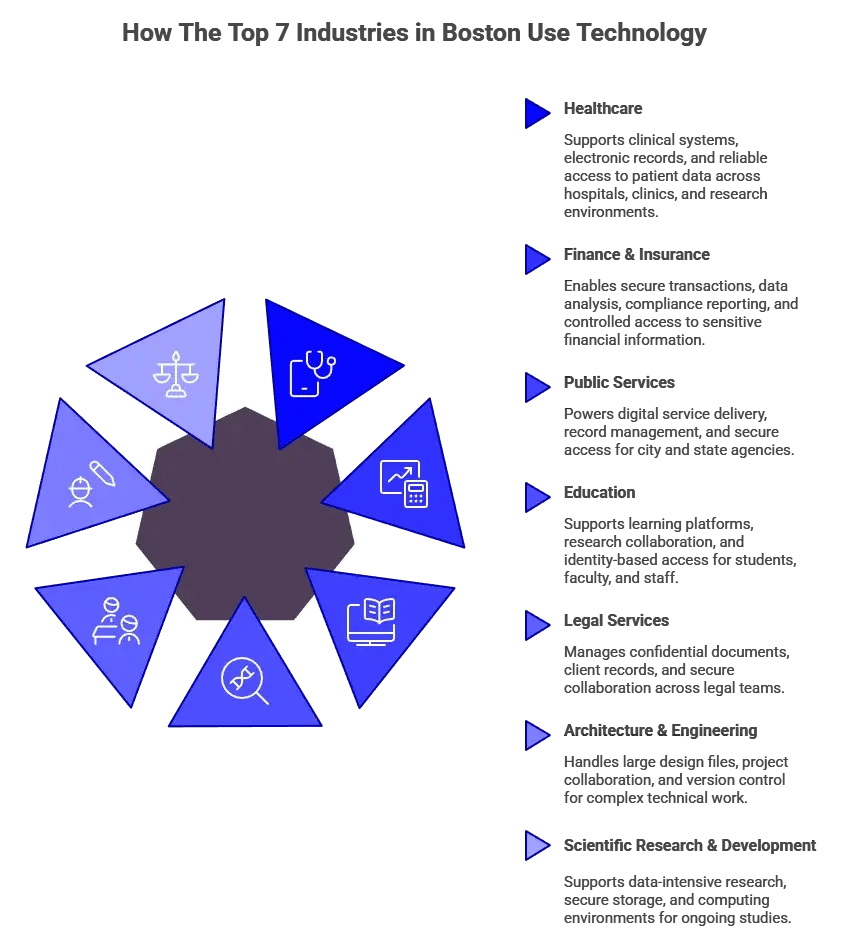
What Makes The Technology Needs of Boston Industries Unique?
1. Strict Data Security Regulations
Massachusetts has one of the most stringent data security laws in the nation: 201 CMR 17.00, which requires any business handling a Massachusetts resident’s personal information to meet strict regulations.
This law was enacted in 2010, and it mandates measures like encryption of personal data and the maintenance of a Written Information Security Program (WISP). Every company in Boston that collects customer or employee data must comply with these standards.
2. Pioneering Data Privacy Legislation
Building on its early data security rules, Massachusetts is now advancing an even stricter consumer data privacy regime. In late 2025, the Massachusetts Senate unanimously approved the Massachusetts Data Privacy Act, a landmark bill aiming to give residents greater control over personal data.
This forthcoming law (also known as MIPSA, or the Massachusetts Information Privacy and Security Act) is poised to be one of the nation’s toughest, granting rights to know, delete, or opt out of the sale of one’s data. It specifically protects sensitive information like health, biometrics, location, and minors’ data.
3. Tech-Savvy Talent
Boston’s concentration of universities and high-tech companies creates an environment where cutting-edge technology adoption is the norm. Massachusetts has the highest share of high-tech jobs in the country and one of the top pools of STEM professionals.
This means Boston businesses, even outside the tech industry, operate amid a highly tech-literate workforce and customer base. Employees and clients in Boston expect modern, efficient digital tools.
How All Industries in Boston Can Benefit From Managed IT Services
|
Healthcare |
Managed IT services can support healthcare organizations by maintaining system availability for clinical applications, monitoring infrastructure to reduce downtime, and managing access controls for staff across care settings. This helps healthcare teams focus on patient care while keeping systems stable and compliant. |
|
Finance & Insurance |
For financial and insurance firms, managed IT services can centralize system monitoring, strengthen identity management, and support secure access to financial platforms. This reduces operational risk while supporting regulatory expectations around data handling and system reliability. |
|
Public Services |
Managed IT services help public sector organizations maintain consistent system availability, manage devices for hybrid workers, and support secure handling of resident and employee data. This improves service continuity while reducing the burden on internal teams. |
|
Education |
Educational institutions benefit from managed IT through stable network operations, centralized identity and access management, and ongoing support for collaboration platforms. This helps schools and universities support students and staff without disruption during academic cycles. |
|
Legal Services |
Law firms can use managed IT services to maintain secure document systems, control access to sensitive case data, and support collaboration tools used across legal teams. This supports confidentiality requirements while keeping legal workflows efficient. |
|
Architectural & Engineering Services |
Managed IT services can help architecture and engineering firms keep design systems available, manage storage for large project files, and support secure collaboration with external partners. This reduces delays tied to system performance or access issues. |
|
Scientific Research & Development |
Research organizations benefit from managed IT through stable infrastructure, secure data handling, and monitored systems that support ongoing research activity. This allows researchers to focus on scientific work while IT operations remain consistent and well managed. |
Work with Trusted IT Support in Boston That Understands Local Industries
The best way for a Boston business to get the IT support they need is by partnering with an MSP that also operates in Massachusetts. By choosing a local IT partner, you have easier access to expert support whenever you need it, and you can work with IT consultants who understand localized needs.
Daystar is a New England-based IT provider that works with organizations throughout the Boston metropolitan area. Our team has extensive experience across multiple industries, and we would be glad to learn more about yours.
You can count on our team for:
- IT support
- IT helpdesk services
- IT consulting
- Cybersecurity services
- IT network support
- IT outsourcing
- and more!
Contact a trusted IT support provider in Boston to get started with more reliable and secure systems.
About Daystar
Daystar is an IT services provider serving businesses throughout New England, including the Boston metropolitan area. The company provides IT support, managed IT services, cybersecurity, helpdesk services, IT consulting, network support, and strategic technology planning for organizations seeking reliable and secure technology operations.


Contact Information:
Daystar – Boston Managed IT Services Company
68 Harrison Ave Suite 640
Boston, MA 02111
United States
Keith Bamford
(888) 507-8067
https://www.daystarinc.com/